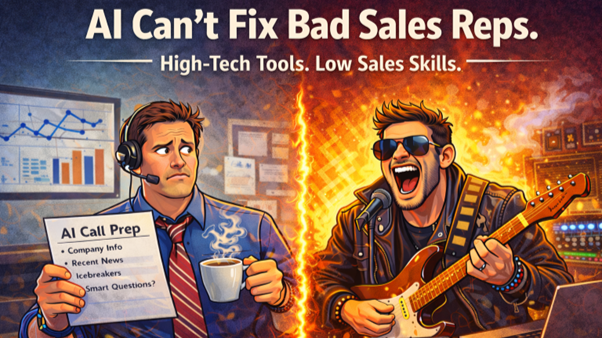
AI can make your reps sound smarter, but it can’t make them better at selling.
On paper, things look great. The pipeline’s fat, full of “opportunities.” But dig deeper and you’ll find the same ugly truth: nothing’s moving. Deals have stalled. Decision-makers have vanished. And everyone’s pretending it’s fine. So what’s really going on here?
Sales today is bloated, broken, and bizarrely stuck in the past. Scripts from the '90s. Metrics that reward noise over value. Teams burning out while buyers burn bridges because they don't respect sales reps.And yet... we keep playing the same game.It’s time to blow it up.
Here's our library of previous articles we've published.
Leaders of foreign companies are sweating more than usual here in equatorial Singapore. The country’s Ministry of Manpower (M.O.M.) has been turning up the heat, demanding firms massively increase their local hires for senior management positions. Regulations are coming, they warn. More foreign hires will no longer be allowed.
Here in Singapore, you often hear these comments from business leaders: “I walked on to my sales floor and could hear crickets chirping.” Or, “I thought I was in the accounting department it was so quiet.” Whatever the remark, the point is the same: A noiseless sales team means people aren’t selling. You don’t need a fancy business degree to know this means trouble.
Companies with sales teams both big and small should have a sales methodology – a system sales reps follow in order to win deals. There’s a lot of options out there. Some of the bigger, more widely used, methodologies include SPIN Selling, Bosworth’s Solution Selling, Miller-Heiman’s Conceptual Selling, or Sandler.
Years ago I found myself having drinks with former President of a large Hollywood movie studio. I was way out of my league and did what you’d expect, I drank too much and pitched him a movie idea that was partially made up on the spot. I wanted to bring the biggest names in Hollywood, China and Bollywood together in one epic global romantic comedy designed to appeal to billions of moviegoers around the world.
Are you a moron or is your extended family a bunch of idiots? It turns out insults can tell a lot about where people come from. And, believe it or not, global insult patterns can be applied towards strengthening multi-national teams and even deciding what to sell and where to sell it. Really.
There’s a shift happening in B2B sales, and most teams are too buried in spreadsheets and dashboards to notice. Here’s the short version: Buyers are getting smarter. Sales teams are falling behind. This isn't just about missed targets or longer deal cycles. It is a full-blown Sales Recession, and it’s being fueled by a simple truth: buyer skills are rising while seller skills are in decline. Here are a few of the key data points I've dug out that lead me to this conclusion:
Sales teams today are like 19th century ironclad warships, mixing modern advancements with outdated practices and becoming less effective as a result. Those who hold on to legacy tactics instead of fully embracing a buyer first, consultative, and self-service driven approach will struggle to keep up as the market evolves.
Instead of using basic, transactional questions, start using thoughtful, insight-driven questions that add value. That means asking questions that: *Make the buyer think - instead of just reciting answers they’ve given a dozen times *Position you as an expert - because you actually bring something to the conversation *Reveal deeper insights - that the prospect might not even realize about their own business Here’s a cheat sheet...
Sales reps today are way too comfortable hiding behind emails and LinkedIn messages.
Traditional training methods often fall short of equipping teams with the skills needed to excel. Enter small group coaching: a transformative approach that bridges the gap between knowledge and real-world application. By combining the power of community, accountability, and hands-on practice, small group coaching empowers sales professionals to adapt, thrive, and drive measurable results.
Get ready for a spooky business tale! In this cross-cultural mishap from my book The Accidental Business Nomad, a ghost in our Manila office ended up costing us more than just a scare. Curious about how a $20 solution could’ve saved us a fortune? Read on, if you dare...