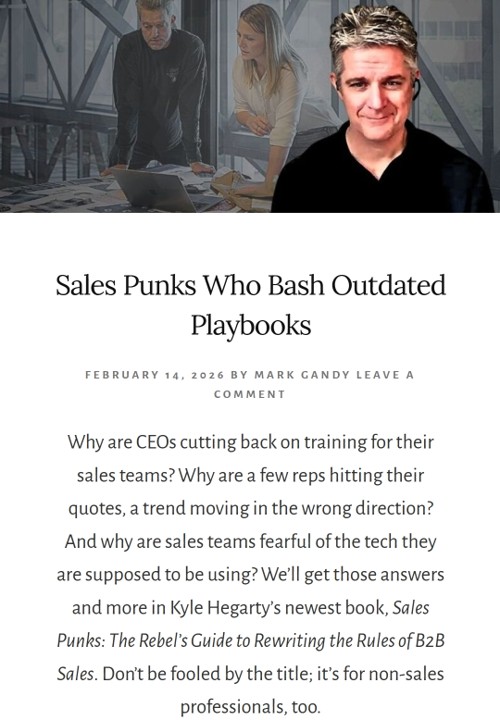
AI can make your reps sound smarter, but it can’t make them better at selling.
On paper, things look great. The pipeline’s fat, full of “opportunities.” But dig deeper and you’ll find the same ugly truth: nothing’s moving. Deals have stalled. Decision-makers have vanished. And everyone’s pretending it’s fine. So what’s really going on here?
Sales today is bloated, broken, and bizarrely stuck in the past. Scripts from the '90s. Metrics that reward noise over value. Teams burning out while buyers burn bridges because they don't respect sales reps.And yet... we keep playing the same game.It’s time to blow it up.
Here's our library of previous articles we've published.
People might be shipping fewer items globally, but they are shipping more data and ideas than ever before. Trade, in other words, has gone digital and this is something that is harder to measure than how many containers pass through a port. Globalisation is not dying, it is shifting from products to services.
Kyle Hegarty joins the Business Blast Podcast to share some unconventional global leadership ideas that can help drive success when doing business in foreign markets. https://anchor.fm/businessblast/episodes/Kyle-Hegarty-Cross-Cultural-Teams-e2mger/a-a70qvd
This 3 minute mini-podcast take you behind the data of American communication styles and how to drive clarity when working with teams overseas. https://www.youtube.com/watch?v=MBDEQtNeZIc&t=56s
This case study looks at how the Lufthansa Systems, in partnership with Leadership Nomad, created and delivered a world-wide intercultural communications program.
What can happen when one team member doesn't speak up? Here is a 3 minute story of how one global team lost out on one of the biggest opportunities of all time.
This 4 minute webinar looks at how one company saved a million dollar a year client by using culture data to fix a rather unusual misunderstanding. The story may sound strange but cross cultural miscommunication issues like this happen daily and cost companies fortunes. Here's how to avoid them!
Greg Getty loves his spreadsheets. Spending twelve years within sales teams, he routinely hit his targets by staying disciplined and organized compared to his colleagues. It wasn’t surprising that he rose up the ranks within several tech firms and found himself as the VP of Sales and, when the company expanded overseas, his role went global. It was at this point where something went wrong.
Case study summary here
Singapore’s 2018 Budget includes a new Enterprise Development Grant (EDG) designed to help firms internationalise. This is welcome news, but with today’s growing climate of global protectionism and fragmentation, it will take more than grants and tax breaks to help firms navigate overseas expansion in this post-globalisation era.
The Year of the Dog begins this week which means, among other things, this is the season when western companies fall over themselves by slapping zodiac animals on their products in hopes of appealing to Chinese consumers. Gucci dog purse, anyone? At the same time, digital payments in China continue to accelerate. Last year, the Chinese New Year tradition of ‘hong bao’ – where cash-filled red envelopes are given as gifts – saw 46 billion electronic transfers. Yes, billion.
Overseas business deals are part of the global landscape but often bring serious unintended disruption. Just ask Cardiff City, where foreign investment caused their soccer team to turn from blue to red. What happened in this Welsh town is a story about the challenges of investing abroad as well as the growing trend of Asian investment finding its way west.
How do you find sales people when the APAC region is so competitive? Is it a mistake to bring in your sales team from another country? How important is it to hire local? In this podcast, Kyle Hegarty, from Leadership Nomad answers the most pressing sales team questions when it comes to growing across Asia.
Congratulations! You’ve just been promoted. The company wants to take all that great work you’ve done with your team and repeat the success at the global level. You’ve got good instincts, you’re a “people person” and have a proven track record of getting results.
Selling across cultures requires a revised set of sales skills. Traditional sales processes including sales stages and how pipelines are measured may need to be reconsidered and adjusted. Sales methodologies – your approach and philosophy to working with prospects and clients – also may need to be adjusted based on different markets around the world.
This is Part 1 of a 2-part Globig Podcast Series about sales strategy and what you need to know about the Asia Pacific market. Globig’s guest is Kyle Hegarty.
Published in the Straights Times, this article explores the key lessons learned from global companies struggling to adapt in this new power-sharing environment.
One of the quintessential Disney rides from several of their parks is “It’s a small world.” As Disney continues its expansion overseas with new theme parks, movies, educational programs and all-other-things Disney, the company continues to provide a great on-going case study for how brands wrestle with the challenges of a world packed with different local and regional preferences and tastes. In many cases, it turns out it’s not such a small world after all.
Companies both large and small have global footprints in ways few imagined even one or two decades ago. While the geopolitical conversations across the world today are shifting towards what Singapore Finance Minister Heng Swee Keat called a more “inward-looking mood,” with Brexit and Trump’s populism, the business environment continues to globalize. Many businesses need to be global in both operations and mindsets in order to stay ahead of the competition and even survive.
In their attempt to break into the Chinese market, Victoria’s Secret seems to have been caught with their pants down. Their most recent fashion show in Paris last December was intended to win over Chinese shoppers as the company is in the process of opening their first stores on the mainland. But critics saw things differently. The Global Times called Victoria’s Secret “the latest international brand to rub Chinese consumers the wrong way with ill-conceived Chinese-inspired elements in its designs.”
For most of his big assignments away from Head Quarters (HQ), Leroy Chiao says communicating back to the main office back in Texas was one of his biggest challenges. He specialized in leading elite teams and they worked in remote locations far, far away from their organization’s hub. Communication was tough. The team back home didn’t always seem to understand the local environment where Chiao and his team had been sent.
Angela Merkel really doesn’t like Multiculturalism. As far back in 2010 she declared the idea a failure. Ever since, she’s argued against it. “Multiculturalism leads to parallel societies, and therefore multiculturalism remains a grand delusion,” she’s said in her direct, German way.
Congratulations! You’ve just been promoted. The company wants to take all that great work you’ve done with your team and repeat the success at the global level. You’ve got good instincts, you’re a ‘people person’ and have a proven track record of getting results.
A frazzled commuter talks into her headset during her morning commute. Her colleague on the other side of the world is standing outside a bar, desperately trying to hide the fact that he’s had a few cocktails. It’s 9pm where he is and he’s wobbling around the sidewalk keeping a respectful distance from the other people on phones doing the same thing. These two are waiting for their partner in London who’s running late from a lunch meeting.
I once sat through a lecture where the teacher explained that people only retain about 20% of what they hear from a class. I can’t remember the rest of his talk, so his story checks out. One of the biggest headaches sales leaders face is how to get sales training to stick with their sales reps. After making real investments in sales training, it’s frustrating to watch 80% of the material vanish after your team walks out of the classroom.